Table of Contents
- What Are Casino Loyalty Programs?
- How Loyalty Program Components Work Together
- Casino Loyalty Models and Mechanics
- How Loyalty Supports Player Retention
- Choosing Rewards Players Can Use
- Personalization and CRM
- The Role of Bonuses and Gamification
- Designing a Casino Loyalty Program
- Measuring Performance and Incremental Value
- Compliance and Responsible Gambling
- Common Mistakes to Avoid
- Conclusion
- FAQ
Build a clearer view of casino loyalty as an operating system for long-term player relationships. Learn how bonuses, VIP tiers, rewards, gamification, and connected software fit together, and how operators can use them to strengthen retention across the customer journey.
Casino loyalty programs are structured reward systems that build lasting relationships between an iGaming project and its players. They are no longer just points and comps. Modern programs are now comprehensive systems that connect visible progress with relevant offers and personal service, giving customers reasons to return after the welcome promotion ends.
The commercial task is to make that relationship worthwhile for both sides. Players should understand what they can earn, while a casino team needs control over the cost of delivering it.
What Are Casino Loyalty Programs?
Such programs represent sets of principles that define how customers qualify for benefits through eligible activity or membership status. Members might receive spendable credits, gain access to exclusive events, or earn recognition for regular participation through levels with different privileges.
In land-based venues, membership can connect gaming with hospitality, including meals and hotel stays. An online casino loyalty program usually focuses on account activity and digital benefits. Businesses operating across both channels can link their customer experience through a shared casino rewards program.
How Loyalty Program Components Work Together
The operational sequence starts with an eligible event, such as a settled wager. Your system applies the configured rules, updates the customer’s progress, and makes the corresponding benefit available. The interface should explain each stage clearly enough for someone to follow it without contacting support.
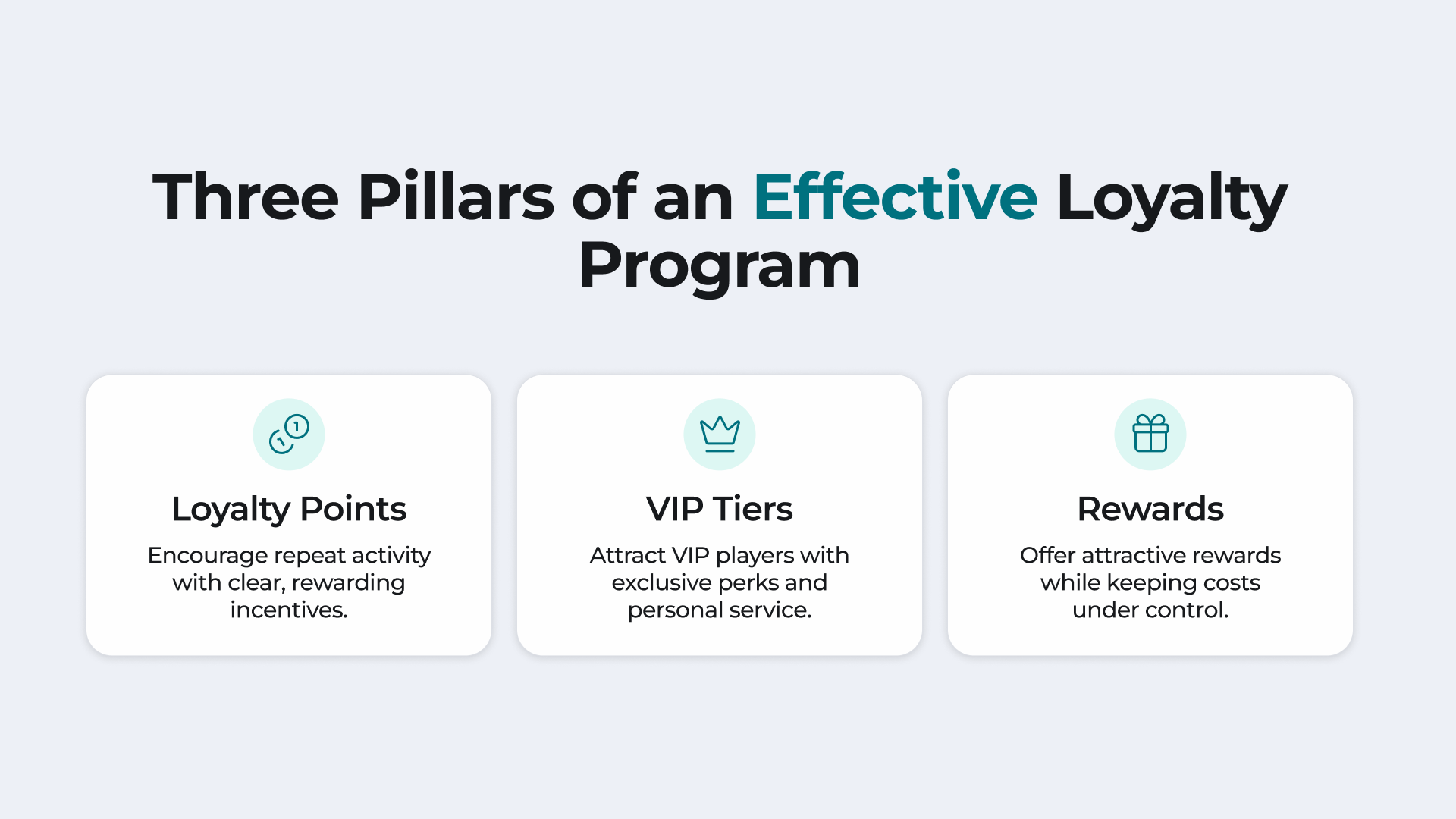
To make the experience worthwhile for players and sustainable for the business, operators need to coordinate three complementary parts of the program.
Earning Loyalty Points
Loyalty points are units credited for qualifying activity and used according to the operator’s rules. Operators set the earning rates alongside game eligibility and contribution weights. This lets the loyalty program economics reflect differences between game categories and promotional budgets.
A settled wager might generate spendable credits and a separate progress score. The former buys rewards; the latter determines status. Keeping those functions clear helps customers understand whether redeeming a prize changes their position in the level system.
An account statement can show where reward points came from and how they were used. Recording adjustments alongside the original transaction gives support teams a practical way to investigate a disputed balance and explain the result.
Moving Through VIP Tiers
Levels group members by qualification criteria and attach defined benefits to each stage. It is important to specify how someone qualifies, how long the status lasts, and when it is reviewed. An annual qualification cycle, for instance, gives casino teams a clear period for assessing eligibility.
A casino VIP program adds individual attention for selected customers, often through a dedicated host. Each project has to define the service commitment behind that label, from response times to event access, so the staff can deliver an appropriate service level for VIP clients consistently.
Redeeming and Receiving Benefits
To find out what rewards are available and the balance required to obtain them, players can consult the rewards catalog. In addition, there are automatic allocations, such as weekly rewards, that are issued according to a set schedule. It should be clearly explained when a reward becomes available, how it is issued, and what terms and conditions apply to its use.
Another example of such automatic rewards is loss-based cashback. Members receive a share of eligible net losses over a defined period. For example, at a 5% cashback rate, €100 in eligible net losses would generate a €5 credit. The terms determine whether this arrives as withdrawable cash or promotional funds with further conditions.
Casino Loyalty Models and Mechanics
In casino loyalty programs, operators often combine different models and mechanics to suit their audience and business goals. The challenge is to make these elements complement each other without driving up costs. The following comparison helps outline purposes, risks, and key performance metrics.
| Model or mechanic | Useful for | Main risk | Measure to watch |
|---|---|---|---|
| Points-based | Giving members a choice of redeemable benefits | Unclear exchange value | Redemption rate |
| Tiered | Organizing privileges around visible progression | Unreachable qualification thresholds | Progression and retention by level |
| Recurring cashback | Providing a predictable entitlement | Cost exceeding incremental revenue | Net contribution after reward costs |
| Challenges and achievements | Adding specific goals and milestones | Excessive pressure to complete tasks | Participation within protection limits |
| Tournaments and events | Creating scheduled occasions for participation | Concentrated prizes with limited wider engagement | Repeat participation across eligible cohorts |
| Hybrid model | Combining status, redemption, and recurring offers | Overlapping rules and duplicated spending | Total program contribution |
The choice depends largely on what your audience finds useful and what your team can run reliably. A straightforward structure gives a new brand room to learn, while an established operation may have enough behavioral data to support several connected paths.
How Loyalty Supports Player Retention
Player retention measures whether customers remain active over a defined period. The recognizable privileges and accumulated progress give them continuity between visits. The main point to consider is that the more consistent the experience feels, the stronger the basis marketing teams have for building repeat relationships.
For the business, that continuity can improve lifetime value (LTV), the expected net contribution from a customer over the relationship. Maintaining an established audience also gives acquisition spending more time to pay back. The reward budget still needs to leave a commercial return.
A loyalty program also generates information about preferences. If, say, a member chooses event access over gaming credits, this gives your team a useful signal for future offers. Over time, these decisions can improve service and help your brand stand apart through a more relevant experience.
Choosing Rewards Players Can Use
A casino rewards program needs benefits that customers can recognize, access, and enjoy. A large catalog is undoubtedly important, but it becomes useful when the route to claiming something worthwhile is easy to understand.
Gaming incentives can include free spins on eligible slots, account credits, or entry to a tournament. Show the usable value alongside the main conditions. Someone claiming a game-specific award should immediately see where it works and when it expires.
Service and experience benefits provide another route. Dedicated account management can simplify communication for established customers, while merchandise or invitations to exclusive events add a tangible connection with the brand. Priority withdrawal processing is also a possible service privilege within the operator’s payment procedures.
Status itself needs visible substance. Early access to a new feature or a member event gives tiered rewards meaning beyond their names. For a casino VIP program, the quality of the host relationship can become particularly important when customers expect personal assistance.
Personalization and CRM
CRM gives your team a data-driven working view of each customer and a way to coordinate communications. For casino loyalty programs, it connects membership information with lifecycle stage and preferences, so the next interaction follows logically from what came before.
Start with correctly differentiated segments. New members may need a simple introduction to their benefits; established customers can receive information about privileges they already qualify for. Game preferences then help determine which eligible offers deserve attention.
For members in VIP tiers, coordinate automated messages with the personal assistant’s conversations. A shared contact history helps colleagues pick up an unresolved request and avoids sending contradictory information through different channels.
Consider a player who regularly chooses live tables. A tailored message can explain a relevant entitlement or invite them to an appropriate event. Once it has been claimed, the next communication should reflect that change. This reduces repetitive reminders and makes the journey feel coherent.
Bonus sensitivity describes how strongly someone responds to promotional incentives. You can assess it by comparing behavior when an offer is present with activity during other periods. Use that insight to calibrate spending and communication frequency, with suitable exclusions for customers requiring protection.
Geography also comes into play when choosing language, currency presentation, and locally suitable benefits. Set contact preferences and protection restrictions before selecting recipients. Within that eligible audience, personalization helps your team make better use of the information already available.
The Role of Bonuses and Gamification
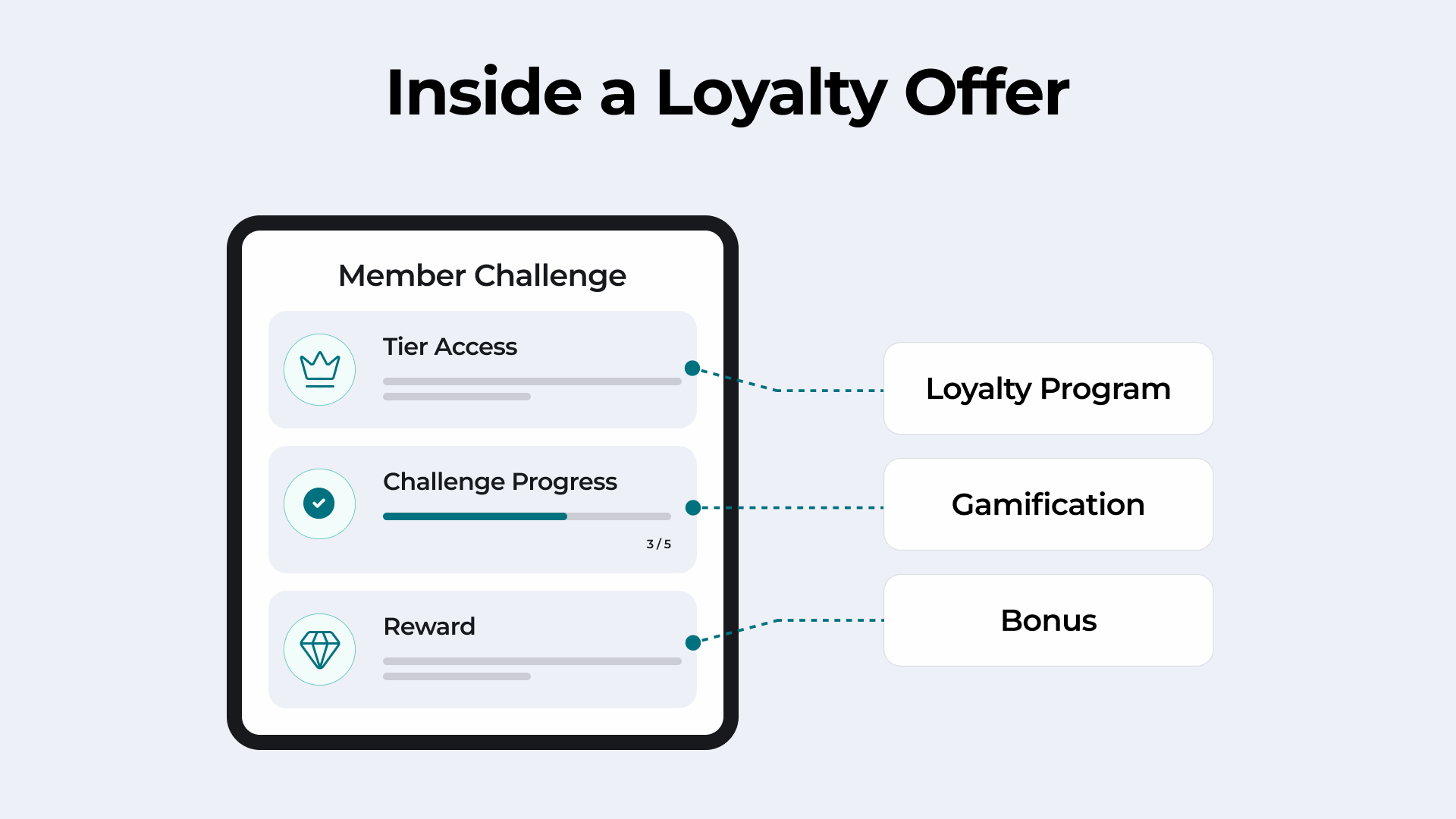
A casino loyalty program establishes ongoing rules for earning rewards and accessing status-based privileges. Within that structure, operators can combine individual incentives with interactive features to support long-term participation.
Bonuses provide specific incentives for both acquisition and retention. A reload credit, for instance, rewards a subsequent deposit under stated terms. Such offers can form part of the loyalty program or run as separate promotions.
Gamification gives members goals to pursue and feedback on their progress through challenges and achievements. Tournaments add competition. All of this adds a new dimension to the gameplay, linking individual sessions to broader, overarching goals and increasing player engagement.
Suppose a member completes a challenge available at their tier and receives a bonus. In this case, loyalty rules determine eligibility, gamification provides the goal, and the incentive delivers the reward.
Designing a Casino Loyalty Program
Successful casino loyalty programs begin with a specific commercial objective. Choose the audience and the change you want to support, such as improving first-month retention among eligible new customers. That decision gives the design a clear purpose and keeps the initial scope manageable.
First, map the existing experience. Look at where people stop participating and what support teams hear about the current offer. If members struggle to understand their benefits, simplifying the claim process may be a useful starting point.
Next, set the reward economy. Decide how value is earned and redeemed, then model the expected cost across customer groups. Include the effect of overlapping campaigns so the total commitment stays visible as participation grows.
For a casino loyalty program, outstanding reward points also belong in the forecast. Members may claim accumulated benefits after the campaign that generated them has ended, so track unredeemed balances alongside current spending when planning future budgets.
Work through a simple scenario before setting thresholds. If a member receives a recurring credit and qualifies for an additional milestone prize, calculate both against the expected contribution from that relationship. This is where teams can point out a combination that looks generous but at the same time leaves little margin.
Those rules then need casino software solutions that make it possible to apply them consistently. When assessing casino loyalty software, follow the complete flow from activity data to credited benefits and reporting. Ask how the system updates customer status and shares information with CRM.
At SoftGamings, the casino platform brings loyalty and gamification together with CRM and reporting in one operating environment. This integrated approach extends across the core functions needed to run and grow an iGaming project, from player management to payment infrastructure and game aggregation.
With the casino API, connected games exchange data with the platform through a standardized integration layer, which supports stable communication and keeps the technical workload manageable for the operator.
For an existing casino with an approved operational framework, a loyalty management platform provides a comprehensive set of tools for strengthening retention through configurable rewards and progression. It connects incentive mechanics with behavioral data so operators can develop a more relevant long-term relationship with their audience.
For either scenario, operators can use a full-featured loyalty solution rather than build the required capabilities piece by piece. The right software turns the program design into a working system where rules, rewards, player data, and reporting stay connected.
Measuring Performance and Incremental Value
Evaluation starts with the behavior you intended to change. Assign players to cohorts based on a shared starting point, such as their first deposit month. Define the population and observation period for each metric, then keep those definitions consistent across reports so player retention remains comparable.
| Metric | What It Indicates |
|---|---|
| Activation | Whether eligible members start using the scheme |
| Repeat deposit rate | How many first-time depositors deposit again within the selected period |
| Cohort retention and churn | Whether defined customer groups remain active or reach the inactivity threshold |
| Redemption and tier progression | Whether members use their benefits and move through the structure |
| Net gaming revenue and LTV | How much economic value the relationship produces |
| Incentive cost | How much the operator spends delivering the offer |
| Abuse and protection indicators | Whether participation creates issues requiring investigation or intervention |
Among the financial metrics, net gaming revenue (NGR) shows gaming revenue after the deductions specified in your reporting model. Promotional costs should be deducted only once, so agree their treatment with finance and apply it consistently across the analysis.
To estimate incremental value, compare the tested campaign with what would have happened without it. A control group provides that baseline: it is a randomly selected, comparable part of the eligible audience that does not receive the campaign. Existing contractual entitlements remain in place.
For example, compare a new optional offer with the standard experience over the same period. If recipients generate more revenue, subtract the additional delivery costs and assess whether the difference is statistically credible. A longer observation window can show whether the improvement lasts after the promotion ends.
Imagine the revenue difference is €8 per eligible customer, with €5 in additional reward and delivery costs that have not yet been deducted. The remaining €3 is the contribution to assess against the operating effort. Scale this calculation across the eligible audience before increasing the campaign budget.
Monitor individual mechanics alongside the total program. A popular prize can improve redemption while shifting demand away from another benefit. Keeping the overall result visible helps you decide which changes actually move the needle.
Compliance and Responsible Gambling
Compliance sets the conditions under which a program can operate. Build eligibility checks into the design, with accessible terms explaining how benefits are earned and used. Self-exclusion status and marketing preferences should inform campaign selection and communication across connected systems.
Apply the rules relevant to each target market. Wagering requirements specify the qualifying turnover needed before associated funds become withdrawable. For example, according to UK Gambling Commission (UKGC) rules effective January 19, 2026, incentive wagering in Great Britain is capped at 10 times the promotional amount. Restrictions also apply to mixing gambling product categories within one incentive.
Protection controls also determine when promotional contact must stop. UKGC guidance requires operators to prevent targeted marketing and new monetary bonus offers where strong indicators of gambling-related harm have been identified. Automating these exclusions helps teams act promptly across customer journeys.
VIP handling deserves specific oversight. The Commission’s high-value customer guidance sets standards for assessing and managing the risks of individualized incentives. Build those checks into host workflows, with regular review and clear responsibility for decisions.
These requirements affect design choices throughout the scheme, from qualification periods to campaign triggers. Legal and compliance teams should review the proposed rules before launch. Industry overviews like this can help frame the main considerations, but they cannot replace jurisdiction-specific legal advice.
Common Mistakes to Avoid
1. Changing qualification rules mid-cycle. Members plan around published conditions, so changes during an active cycle can create confusion or disputes. If the rules still need to be revised, explain when the update takes effect and preserve entitlements already earned under the previous terms.
2. Testing too many changes together. Altering qualification thresholds and prize values simultaneously makes their individual effects harder to identify. Design experiments around the specific decision you need to make.
3. Duplicating awards across channels. A message in the app and an email should reference the same entitlement. Check how claims are recorded so one offer cannot accidentally produce two payouts.
4. Confusing poor campaign economics with player abuse. An offer can lose money even when participants follow the rules. Review the campaign design and reward costs on their own, and reserve abuse investigations for cases with evidence of prohibited activity.
5. Repeating the same incentives indefinitely. Review participation patterns and customer feedback. Refresh benefits selectively while preserving a recognizable structure and clear expectations.
Conclusion
A strong casino loyalty program works as a connected system rather than a collection of isolated rewards. Player progress, incentives, communication, and measurement should support the same retention logic and remain understandable to both customers and the teams operating the program.
That makes the long-term objective broader than increasing reward value. The goal is to build a retention model that can adapt to player behavior, stay manageable as the business grows, and continue producing value on both sides of the relationship.
FAQ
How does a casino loyalty program work?
The operator defines qualifying activity and the corresponding entitlement. Connected software records eligible events, calculates the result, and makes benefits available through automatic delivery or a claim process. The customer can track their position through the account interface.
Which models and mechanics are commonly used?
Common choices include redeemable-point systems and membership levels, supported by recurring credits or interactive achievements. Scheduled competitions add another engagement format. Operators can combine these elements into a hybrid structure built around their audience.
How does a casino VIP program fit into loyalty?
It provides enhanced service and selected privileges to qualifying customers. It can sit within a broader membership structure or operate as a dedicated relationship model, with individual hosts and specific eligibility procedures.
How does casino loyalty software work?
Casino loyalty software can be implemented within different iGaming products, depending on the operator’s setup. If a casino already has its own platform, a standalone loyalty management platform can add the full functionality, connecting everything from eligibility rules and reward delivery to player progress and reporting.
How can operators implement a loyalty program when launching a new casino?
When launching a new project with SoftGamings, operators choose a platform edition that matches their business goals and preferred level of control, whether Turnkey casino software, White Label solution, or another setup. Loyalty functionality can be implemented from day one, without adding a standalone product later. The platform back office then provides access to all the necessary tools, from reward rules and player management to CRM workflows and game lobby configuration.
Can loyalty improve retention?
Yes. Loyalty is one of the main ways to strengthen retention because it gives players clear reasons to return over time. Visible progress, relevant rewards, status benefits, and personalized offers help turn separate visits into an ongoing experience and make the relationship with the casino feel more consistent.
How can operators reduce abuse?
Use transparent terms alongside identity, device, and payment checks to identify suspicious linked activity. Investigate flagged cases and keep records of decisions. Review campaign economics separately, so commercial performance and evidence of manipulation are assessed on their own merits.
