


Table of Contents
Gamification in iGaming adds a structured layer of goals, progress, recognition, and rewards around casino or sportsbook activity. It can give players more reasons to return, explore new content, and build a longer relationship with the brand.
For operators, that supports cross-product discovery and player value without making every campaign depend on a larger bonus.
The technology behind this layer matters. A casino needs player data, bonus logic, CRM, loyalty tools, and reporting to work together if missions and rewards are to appear at the right moment. Online casino platforms bring these operating functions into one environment and give operators different levels of gamification control depending on the chosen launch model.
Still, adding points or a leaderboard does not automatically create loyalty. A mechanic works when it taps into a clear player motivation and serves a measurable business objective. Without that connection, it becomes another widget competing for attention.
What Gamification Changes for an Operator
Games already contain rules, uncertainty, and rewards. Platform gamification creates a wider journey across sessions and products. A player may:
- complete a welcome mission;
- earn experience points;
- move to a new level;
- enter a tournament;
- redeem a reward in a casino shop.
Each action connects the current visit with a reason to come back.
This wider journey can support several operator goals. Onboarding missions help new players understand the product. Progress systems build continuity between visits. Challenges can introduce a sportsbook player to casino content or reactivate someone whose activity is falling. Tournaments create short peaks around events, while loyalty tiers support a longer relationship.
The value therefore comes from guiding behaviour towards a defined outcome. Before choosing a mechanic, the operator should decide what needs to change. First-week activation, return frequency, cross-sell, repeat deposits, or retention within a specific segment — any of these can be the operator’s objective.
The Core Mechanics Do Different Jobs
The most effective programmes combine several gamification mechanics, but each one needs a distinct role.
Progress and status. Points, experience, progress bars, levels, and badges make advancement visible. Points can act as feedback or a reward currency; levels show a longer path; achievements recognise meaningful milestones. The rules and benefits must remain easy to understand, especially when status affects perks.
Missions, challenges, and streaks. These mechanics give the player a defined objective, from completing profile steps to trying a new game category. Daily tasks encourage frequency, while seasonal quests can support a campaign for several weeks. Difficulty should match the player’s experience, and streaks need grace periods or freezes so that taking a healthy break is not treated as failure.
Competition and community. Leaderboards, tournaments, leagues, and team goals add social comparison or collaboration. Fair design is especially important here. Smaller brackets, activity-based scoring, and regular resets give more players a realistic chance to progress instead of leaving the same high spenders permanently at the top.
Rewards and choice. Free spins, tournament entries, cashback, access privileges, virtual currency, and shop items turn progress into value. A reward store gives players more control over what they receive. Exchange rules, expiry dates, and wagering conditions should be visible before participation.
The most effective approach here is to combine these elements into one loop rather than displaying them as isolated features. The scheme below shows how a player journey can move from a relevant trigger through challenge, feedback, and reward to the next useful action.
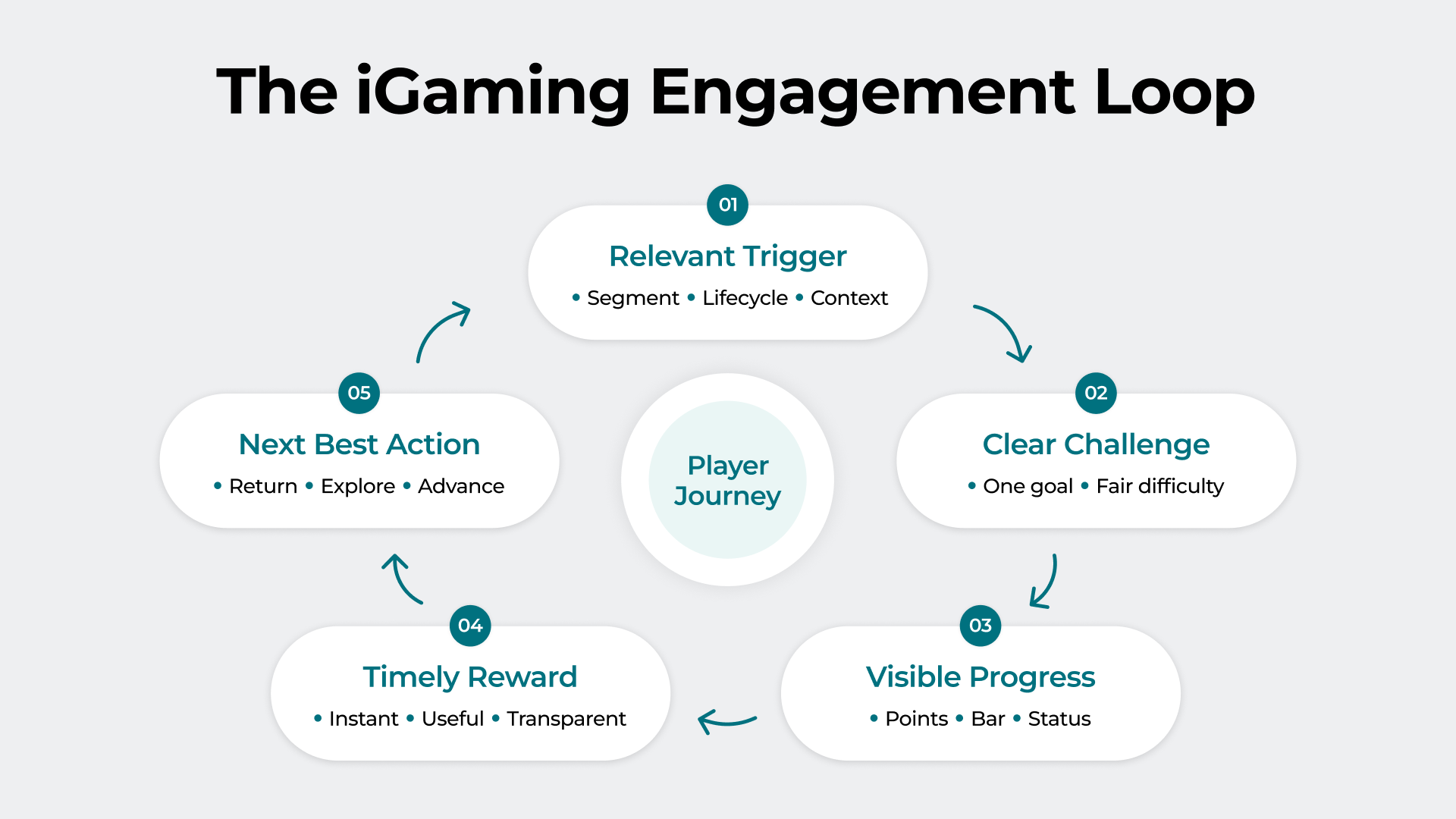
What Is Important for Effective Gamification Mechanics
Timing is the first test. If a player completes a mission during a session, the progress update and recognition should follow immediately. A badge delivered the next morning loses its connection with the action that earned it. Reliable real-time processing is therefore part of the experience, not only a technical detail.
Relevance matters just as much. The same challenge will not suit a new registrant, a regular slots player, a sportsbook customer, and a dormant VIP. Segment, lifecycle stage, preferred product, activity pattern, and risk profile should influence which goal appears and when.
Personalisation also controls cost by avoiding rewards for behaviour that would have happened anyway.
Finally, the effort-to-reward balance must feel fair. Easy tasks become background noise, while unreachable goals cause players to disengage. Clear rules, visible progress, attainable milestones, and a useful reward create the middle ground where a mechanic can hold attention.
How Gamification Is Becoming More Adaptive
The market is moving from static calendars toward behaviour-triggered journeys. Rule-based automation can already assign different missions by segment and respond to events such as registration, first deposit, product switch, or declining activity.
AI tools can take this further by helping teams select the next suitable challenge, reward, or message from a wider set of signals.
Human control remains important. Commercial logic, bonus budgets, regulatory restrictions, and responsible gambling rules must set the boundaries within which any automated decision is made. If a player shows signs of harm, promotional pressure should decrease regardless of predicted value.
Other developments reinforce the same direction. Mobile-first mini-missions reduce the effort needed to participate, while progress that carries across casino, sportsbook, devices, and communication channels creates a more consistent journey. Social mechanics are also expanding from public rankings to smaller leagues, shared goals, and community events.
Measuring Incremental Gamification Value
Every gamification programme needs a defined objective, target segment, cost, and comparison point. A holdout group or a credible pre-campaign baseline helps distinguish genuine uplift from activity that would have occurred without the mechanic.
The KPI set should follow the intended behaviour.
- An onboarding mission may be assessed through completion, time to first deposit, and early retention.
- A cross-product challenge calls for measuring product adoption and subsequent NGR.
- Loyalty tiers require a longer view of repeat activity, reward cost, retention, and player value.
More sessions or longer play are not sufficient measures of success. Read commercial results alongside bonus cost, complaints, opt-outs, responsible gambling signals, and concentration among high-value players.
A mechanic that increases short-term activity while raising risk or giving away value to already-loyal players needs redesign.
Gamification in the Launch Model Decision
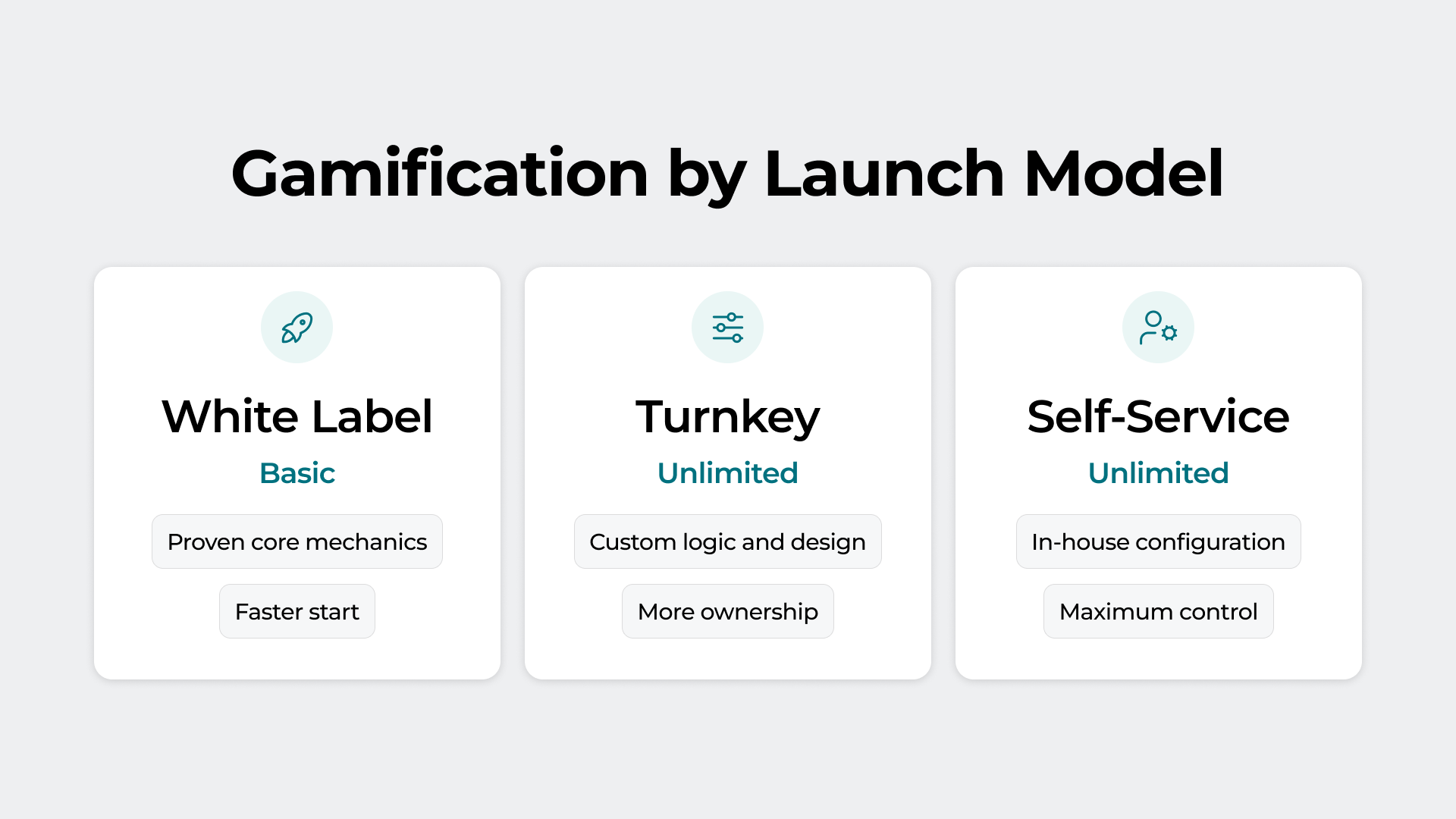
The required level of control should influence the choice of casino launch model. A new operator looking for speed may need proven core mechanics from day one, while an established brand may want custom progression rules, visual design, reward logic, and integrations.
SoftGamings provides this choice within the same casino platform:
- White Label software includes a basic gamification setup and reduces the amount of configuration required from the operator;
- Turnkey and Self-Service models offer unlimited gamification opportunities alongside wider customisation.
For Turnkey projects, this freedom can support a distinct branded journey while SoftGamings provides the platform and development expertise. Self-Service gives an operator’s own technical team the greatest direct control over configuration and further development.
In both cases, the commercial advantage depends on the team’s ability to design, test, and maintain the mechanics it chooses.
Build a System Players Can Understand
Effective gamification connects a clear business goal with a relevant challenge, visible progress, timely feedback, and a fair reward. Operators must then measure whether the target behaviour changed and weigh the result against programme costs and responsible gambling signals.
The real opportunity lies in building a repeatable engagement system across the player journey. When the mechanics are clear, personalised, and technically reliable, they can support stronger retention and product discovery while giving players a more coherent reason to return.