


Table of Contents
- What Is a Social Casino?
- Social Casinos vs Sweepstakes Casinos vs Real-Money Online Casinos
- How Do Social Casinos Make Money? Inside the Social Casino Revenue Model
- Why Do Players Spend Money in Free-to-Play Casino Games?
- What Makes the Social Casino Business Model Profitable
- Legal and Responsible Gaming Considerations
- What Operators Need to Launch a Social Casino
- 5 Common Monetization Mistakes to Avoid
- FAQ
Learn how social casinos turn free-to-play gameplay into revenue and what makes the model sustainable. Find out how virtual currency works, which metrics show business health, what legal factors matter, and five common monetization mistakes operators should avoid.
How do social casinos make money when users can start playing for free? The short answer is optional spending. Coin packages usually lead, while live-ops offers, passes, subscriptions, and advertising widen the revenue mix.
The main point to consider is that a social casino business model treats casino-style play as digital entertainment. Users pay for things like more playtime, progress, or status, but all the credits remain within the game economy.
For operators, the day-to-day reality comes down to timing and value. The project must earn repeat visits, present useful offers, and retain enough margin after costs.
What Is a Social Casino?
A social casino is a free-to-play digital casino-style game or platform that uses virtual currency for entertainment and normally does not pay cash prizes. Its mechanics mimic slots and table games, but the product is positioned as entertainment rather than real-money gambling.
The UK Gambling Commission describes social casino games as gambling-style games in which prizes are not money or money’s worth. Formats may also include poker, bingo, and similar titles.
Players usually receive a starting balance of coins, chips, or credits and can earn more through daily rewards or leveling up. If the balance runs low, they may wait for another grant or purchase a package.
The free-to-play principle means that users can access the core experience without paying, while monetization remains optional. Coin purchases can extend sessions, support progression, or unlock limited-time activities.
In turn, a sweepstakes casino may use Gold Coins for entertainment, while Sweeps Coins, a separate promotional currency, support prize-eligible play and potential redemption. Traditional social casino balances remain non-redeemable, whether they are called coins, premium credits, tickets, energy, or event tokens.
Social Casinos vs Sweepstakes Casinos vs Real-Money Online Casinos
The three models may share familiar games and interfaces. To better understand the difference, follow the value flow: what enters the account, what it enables during play, and whether any winnings can be redeemed or withdrawn.
| Social Casino | Sweepstakes Model | Real-Money Online Casino | |
|---|---|---|---|
| Player expectation | Entertainment and in-game progress | Entertainment with prize opportunities | Real-money play with withdrawable winnings |
| Currency model | One or several non-redeemable balances | Entertainment plus prize-eligible coins | A real-money balance in fiat or cryptocurrency |
| Purchase model | Optional purchases of play-only coins | Play coins sold, prize coins granted or won | Real-money deposits |
| Prize redemption | No redemption for cash or prizes | Winnings redeemable for prizes | Winnings can be withdrawn |
| Monetization focus | Coin packages, passes, subscriptions, and ads | Entertainment-package sales and prize-cost control | Gaming revenue from real-money wagering |
| Legal logic | Consumer protection, age, and advertising rules | Sweepstakes and promotional rules | Gambling licensing and local regulation |
The important distinction is the role of each balance. Social products keep value within the entertainment loop, while the sweepstakes format adds promotional prize play. Real-money casinos stand apart: they accept deposits for wagering and operate within the regulatory framework of the relevant gambling market.
How Do Social Casinos Make Money? Inside the Social Casino Revenue Model
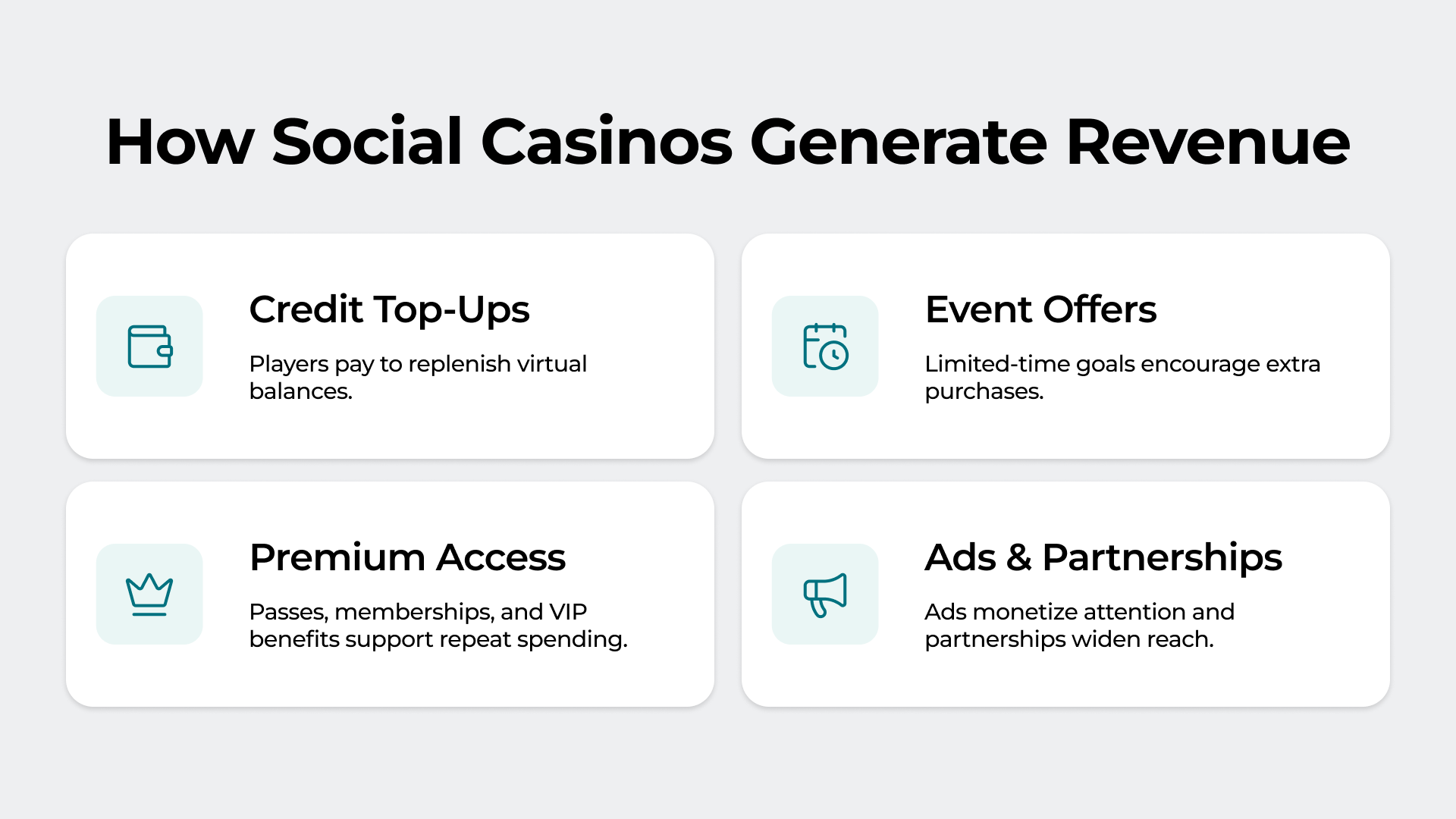
The answer starts with a free core experience surrounded by optional value. Virtual coin packages do the heavy lifting, while live operations create timely reasons for users to return and top up their balances.
There is no universal mix. A casual mobile title may combine rewarded ads with small bundles. A mature project can rely more heavily on events, VIP benefits, and recurring offers. The choice depends largely on audience behavior and acquisition economics.
Virtual Currency Packages and In-App Purchases
Coin packages are the most direct form of social casino monetization, although buying them is optional. Users can rely on free coin rewards or make in-app purchases when they want to extend a session, join a limited-time event, or progress faster.
The main point to consider is that packages usually form a price ladder. A small option lowers the first-purchase barrier, while larger bundles add more play value or selected benefits. What matters in practice is a clear reason for every tier.
The purchase screen should show the real-money price, credit amount, offer duration, and restrictions before confirmation. If players need to decode the offer, purchase friction rises.
Live Ops, Events, and Limited-Time Offers
Live operations are the campaigns and content changes that keep a product active after release and support social casino monetization over time. Daily rewards build routine, while missions, collections, tournaments, and seasonal events give the next visit a purpose.
In social casinos, these mechanics also create purchase moments. If a player wants to finish a mission or complete a collection before an event ends, this is often possible by purchasing credits. The offer works best when it supports that goal rather than interrupting gameplay with a generic discount.
Segmentation improves the cadence. New users need orientation, regular players value continuity, and high-value groups often expect deeper events. Frequency rules prevent campaign overload.
Passes, Subscriptions, and VIP Value
There are several formats that can make social casino revenue models more predictable. Users can pay for event passes, memberships, or an ad-free tier. Benefits may include daily credits, extra missions, or early access.
VIP mechanics add status and recognition. As players reach higher levels, they may unlock service benefits, exclusive access, or added convenience. Visible progress can matter as much as the reward because it gives regular users a longer-term goal.
For traditional online casinos, a loyalty management platform adds a configurable retention layer. It shows how bonuses, tournaments, achievements, and rewards can work as one operating system.
Ads, Sponsorships, and Cross-Promotion
Advertising is usually a secondary stream, especially among users who rarely buy. Rewarded video creates a direct exchange: the player chooses to watch and receives a small credit grant.
As for interstitials and display placements, they need tighter control. An intrusive format may earn an impression while shortening the session. For this reason, teams should read ad yield alongside return rate, session depth, and purchase conversion.
Sponsorships and co-branded events can extend reach when the partner suits the audience. Cross-promotion moves users between titles owned by the same publisher and can reduce dependence on paid acquisition.
Taken together, these components form the commercial core of a social casino.
Data-Driven Retention
To form a complete picture of where the commercial system is gaining or losing momentum, comprehensive retention analytics are essential. Cohorts reveal when users stop returning, while purchase and event data identify the experiences that drive voluntary spending.
Having enough data, social casino teams can then test timing, prices, and content against a baseline. This removes much of the trial and error from live ops because each campaign has a target behavior and a measurable result beyond same-day sales.
Why Do Players Spend Money in Free-to-Play Casino Games?
The same laws of digital entertainment apply here as they do to ordinary online games. People are willing to spend money even when there is no chance of winning cash prizes. It is about something else: investing to upgrade the gameplay and make the experience more exciting. In free-to-play casino games, spending can preserve a session, open a timed activity, accelerate progress, or make an achievement more visible.
Convenience is often the first reason. When users want to continue playing without pausing to wait for a new batch of free credits, they can purchase a package and easily resume their session. For another segment, completion provides the pull: the user wants to finish a collection or reach the next level.
Social motives add another layer. Tournaments create competition, clubs support belonging, and visible status recognizes commitment. Personalization strengthens relevance when offers reflect genuine preferences and lifecycle stage.
Routine matters too. A daily reward brings the user back, and an event turns that visit into a fresh goal. Sooner or later, some engaged players decide that added convenience or progress is worth paying for.
What Makes the Social Casino Business Model Profitable
The social casino business model becomes economically sustainable when lifetime contribution covers acquisition and operating costs. Teams therefore need to know how many users pay, how often they return, and what margin remains after those costs.
It is most sensible to start with a shared metric dictionary.
- DAU and MAU. Daily and monthly active users show audience scale, while the DAU-to-MAU ratio indicates how frequently the monthly base returns.
- Payer conversion. This is the share of active users who make at least one purchase during a defined period.
- ARPDAU. Average revenue per daily active user measures yield across the full daily audience.
- ARPPU. Average revenue per paying user shows payer value.
- Purchase frequency and payment success. One tracks repeat transactions; the other exposes friction between purchase intent and completed payment.
- Cohort retention and churn. D1, D7, and D30 return rates pinpoint when engagement begins to fade. Churn quantifies audience loss over time.
- LTV and contribution. When measuring profitability, calculate LTV on a contribution basis after relevant variable costs. Then compare it with customer acquisition cost and payback time.
No metric should stand alone, and all require context. For example, higher ARPPU can reflect either healthy VIP growth or heavier spending by a shrinking group. Rising DAU adds little value when new cohorts leave early or cost too much to acquire.
A connected back office helps conventional casino teams compare player activity with game performance and business results in one operating view. The same principle applies here: every metric needs an owner and a next action.
Finally, it is important to separate receipts from contributions. Channel fees, media, content, technology, support, fraud, and refunds all sit below package sales. A sustainable social casino revenue model protects margin while preserving the user base.
Legal and Responsible Gaming Considerations
Legal classification follows the product flow. Prize redemption, the local meaning of value, purchases, advertising, and age restrictions all matter. Depending on the market, similar products can receive different treatment.
Great Britain provides a useful reference point. The UK Gambling Commission’s position paper says in-game features are not licensable gambling when prizes stay inside the game, even if play involves spending and chance. This is the logic of traditional social casinos: users may buy credits, but winnings have no cash value.
Age rules form a separate layer and vary by jurisdiction and distribution channel. A social casino may carry an advisory age rating, be limited to adults, or require age gates and restrictions on marketing to minors.
Consumer protection also reaches the purchase journey. Depending on the market and sales channel, operators may need to show real-money prices clearly and explain what users receive with each virtual-currency purchase.
For operators, this translates into a practical checklist:
- terms should explain the balances and purchases clearly;
- marketing must match the product;
- safeguards should reflect the audience;
- counsel should review the complete model before launch.
It is important to take into consideration that overviews such as this one cannot take the place of legal advice. A market-specific legal assessment remains necessary because local definitions and consumer protection rules determine how the model is classified and which requirements apply.
What Operators Need to Launch a Social Casino
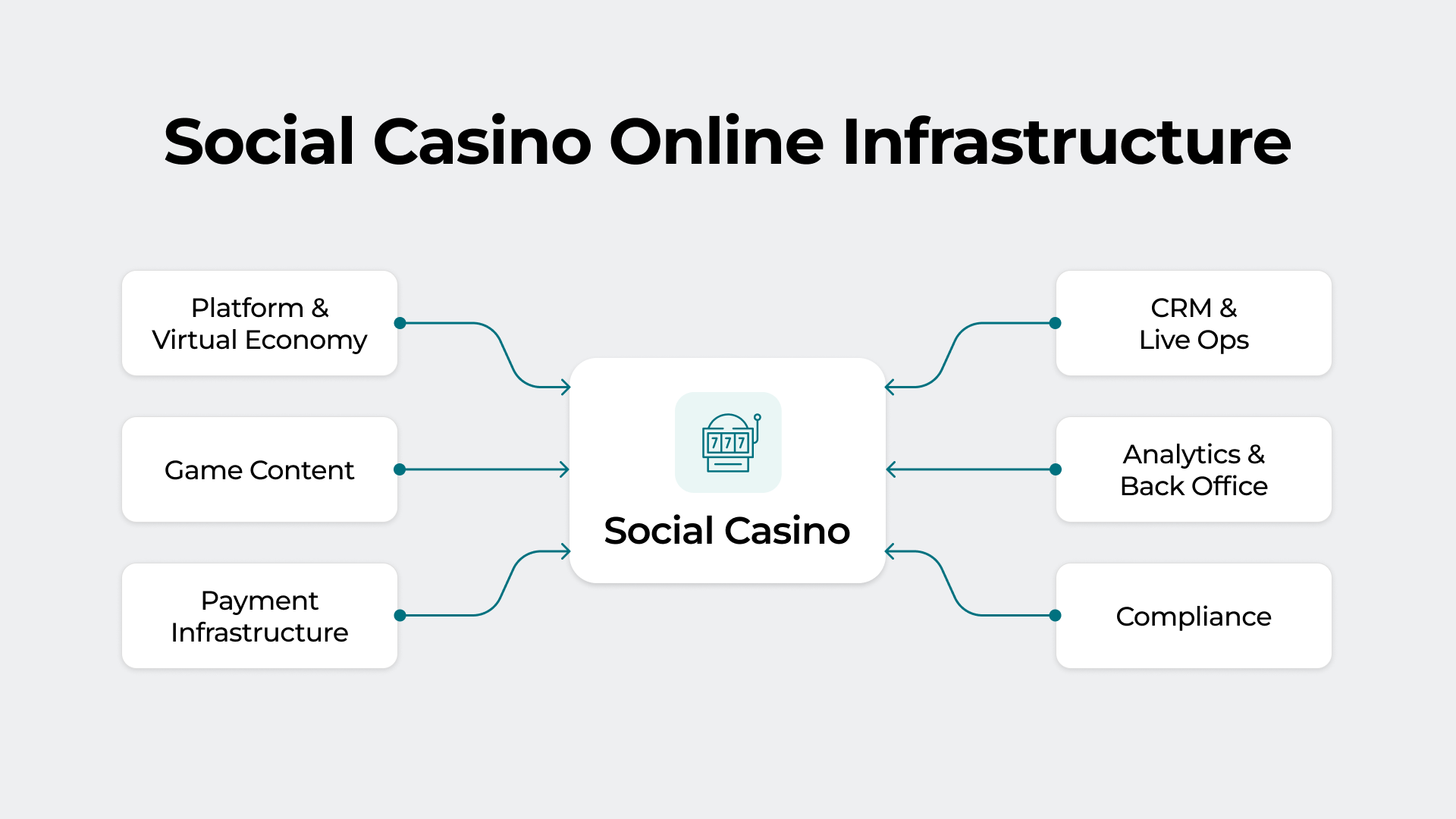
A launch starts with a product definition covering free grants, paid offers, and each balance. This helps avoid rework across architecture, terms, analytics, and operations later on.
The foundation is the platform and virtual economy. The platform core links accounts, games, and the store, while its ledger records balance changes.
For social casinos, iGaming software developers offer turnkey solutions, just as they do for traditional gambling. For licensed real-money projects, SoftGamings’ Turnkey casino software provides ready infrastructure with an optimal level of operator control and customization.
Then comes game content. API aggregation offers a broad game library from launch, and in the case of social casinos, operators can use cross-model aggregators or specialized social casino APIs. The principle is the same as in SoftGamings’ casino games aggregator, where one API gives access to 300+ providers and 40,000+ games.
Payments handle optional purchases of coin packages, passes, and subscriptions through app-store billing or web checkout. For both social casinos and traditional gambling, it is crucial to offer a wide range of payment methods relevant to each target market. Therefore, SoftGamings offers a payment infrastructure setup with extensive coverage: 150+ payment methods and 1,000+ payment options, ranging from traditional bank cards to cryptocurrencies.
CRM and live ops also matter. CRM builds segments and delivers campaigns, while live ops runs missions and limited-time events. Frequency rules prevent overload.
Analytics and control support daily operations when reporting is built into the platform and key data appears in one clear back-office view. Operators can then spot changes early, investigate their causes, and make timely, data-driven decisions.
Finally, operations and safeguards need clear owners. Support resolves player issues, localization adapts the product, and security and privacy controls protect data. Legal review defines the market compliance framework, including age checks and KYC where applicable.
5 Common Monetization Mistakes to Avoid
Revenue problems often begin with a harmless-looking product decision. Before launch, it is better to take the following mistakes into consideration.
- Mixing social and promotional prize mechanics. Redemption changes the player journey and operating logic. Define the complete flow before building the communications around it.
- Hiding value behind coins. Players should see what a virtual currency package costs, how many credits it contains, and what those credits enable before confirming payment.
- Optimizing only for the first purchase. Track later sessions, repeat payments, refunds, and churn. Initial conversion creates value only when subsequent behavior supports it.
- Ignoring mobile purchase friction. Slow loading, weak localization, or a confusing confirmation step can waste high-intent traffic at the last moment.
- Treating safeguards as a late add-on. Purchase limits, age rules, support routes, and marketing suppression affect data models and workflows. So it is necessary to design them early.
FAQ
How do social casinos make money if they are free to play?
They earn mainly from optional in-app purchases of coins or credits. Live-ops offers, event passes, subscriptions, rewarded ads, sponsorships, and cross-promotion add further income. The access is free, which widens the audience of social casinos.
Can a player win real money from a social casino?
Traditional social casinos use play-only balances and do not pay cash prizes. Real money can be won on classic online gambling sites or in sweepstakes casinos. The latter model adds promotional currency for prize-eligible play and potential redemption.
Why do people buy coins in social casino games?
Players buy coins to continue immediately, enter an event, complete a collection, advance faster, or express status. In each case, the purchase adds value to an experience they already enjoy.
Are social casinos gambling?
Many markets treat closed-loop casino-style products as entertainment. The exact classification depends on local definitions of prizes and value, together with the purchase and gameplay mechanics.
What is the difference between a social casino and a sweepstakes casino?
Social casinos may use one or several virtual balances, but these balances stay within the product and cannot be redeemed for prizes. Sweepstakes casinos add a promotional currency used for prize-eligible play, with potential redemption.
What metrics should social casino operators track?
Start with DAU, MAU, cohort retention, churn, and event participation. Add payer conversion, ARPDAU, ARPPU, purchase frequency, payment success, contribution margin, LTV, and acquisition cost to connect activity with profit.
What software is needed to run a social casino?
Just as with launching a traditional online casino, a platform helps integrate all layers within a single container. Furthermore, a robust payment system is required to process in-game purchases, alongside broad access to games, which can be facilitated through API integration.
