


Table of Contents
- What Are Responsible Gambling Tools?
- Why Responsible Gambling Matters for Online Casinos in 2026
- Core Responsible Gambling Tools Players Expect to Find
- Casinos With Responsible Gambling Tools: What Operators Should Provide
- Operator-Side Monitoring and Customer Interaction
- Self-Exclusion, Blocking Software, and Bank-Level Controls
- 2026 Regulatory Context: UK and US Signals
- Responsible Gambling Tools for Prediction Market Solutions
- How to Design a Responsible Gambling Toolkit for an iGaming Platform
- Common Mistakes to Avoid
- Conclusion
- FAQ
Industry growth and player protection increasingly go hand in hand. As iGaming becomes more regulated and technologically advanced, responsible gambling tools help turn broad commitments into practical controls and timely action.
This informational guide explores the responsible gambling framework across online casinos and prediction-market-like products, beginning with the boundaries users can set and moving behind the scenes to operator-led safeguards.
Players can set limits on spending, time and access, while operators monitor risk and intervene when needed. Reporting and referral pathways support that response. These tools are no substitute for professional support or jurisdiction-specific legal advice, but can help reduce gambling-related harm and enable earlier action.
What Are Responsible Gambling Tools?
In practical terms, responsible gaming tools cover controls, data and support routes that help a user set boundaries, understand activity, pause play, self-exclude or seek help. They also include operator workflows that detect risk and guide a proportionate response.
According to the NCPG Internet Responsible Gambling Standards 2026, a full programme should join governance and staff training with player decisions and limits. Support, marketing and evaluation complete the model.
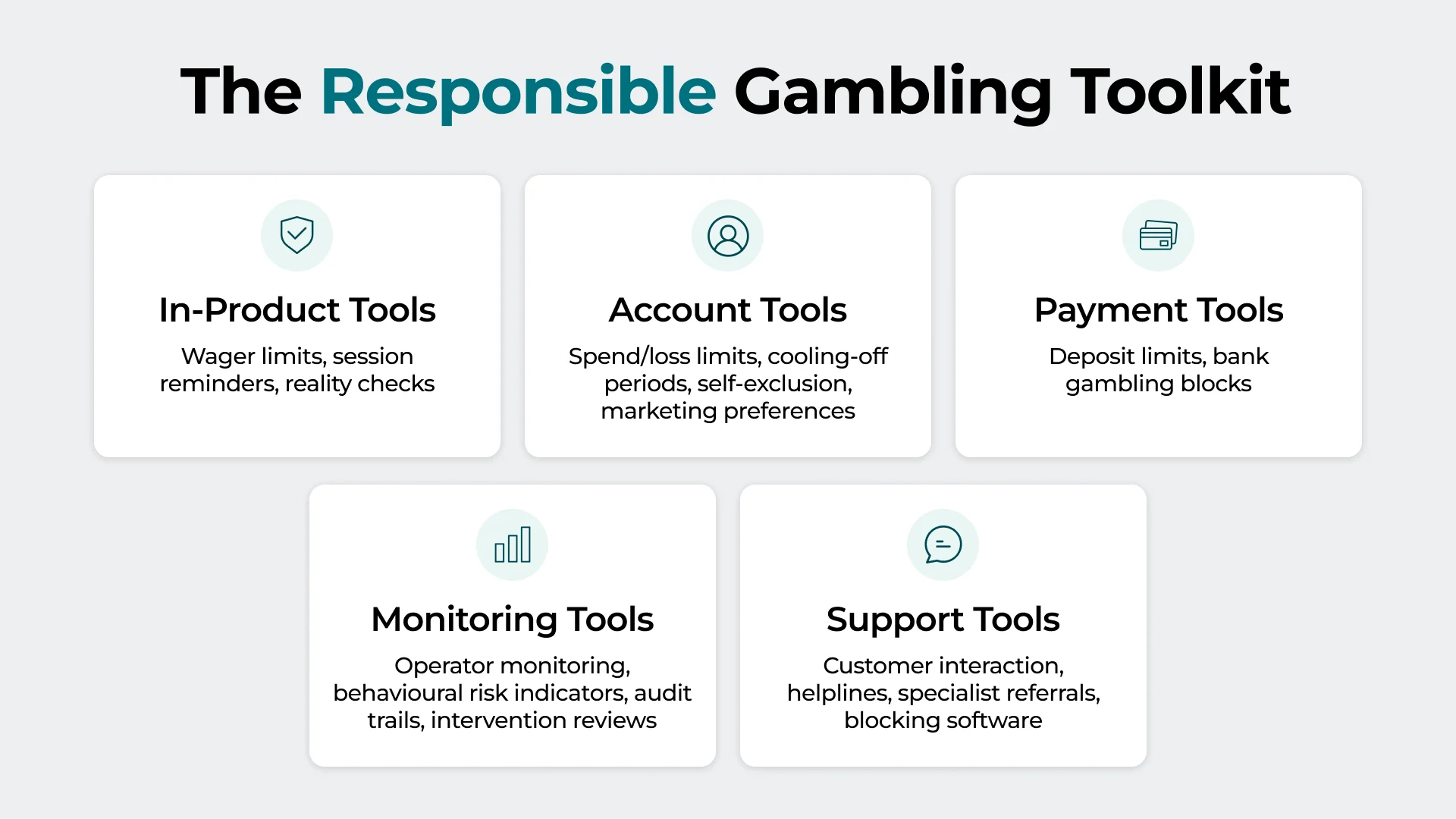
These player protection tools fall into three practical layers.
- Player-facing platform controls include deposit, spend, loss, wager and session limits. Reality checks, time-outs, marketing preferences and self-exclusion also belong here.
- Operator-side controls include behavioural monitoring, risk indicators, customer interaction, audit trails and reviews of whether an intervention worked.
- External services include bank gambling blocks, blocking software such as Gamban or BetBlocker, multi-operator exclusion schemes and helplines. The casino can signpost or connect to them, although another organisation provides the service.
This distinction matters. A limit is part of the casino account; a bank block sits with the payment provider. In the same way, formal self-exclusion follows defined rules, while ordinary account closure is a separate customer-service action.
Why Responsible Gambling Matters for Online Casinos in 2026
In 2026, safer gambling sits at the intersection of compliance, product design, brand trust and long-term retention. For regulated online casinos, consumer protection must be visible throughout the player journey, before risk escalates.
Players should know:
- where to find deposit, spend or session limits;
- what each control covers;
- when a change takes effect.
Age and know-your-customer (KYC) checks must feed the right access rules. Responsible marketing requires contact rules to reflect a player's risk and exclusion status.
Clear intervention workflows complete the picture. Casino support teams need defined steps for contact, escalation and follow-up. The same capabilities belong in due diligence when selecting a casino software provider, since limits, event data and intervention records must work across connected systems.
Well-designed safer gambling tools give players practical control and provide operators with evidence to assess whether safeguards work. That strengthens brand trust and gives long-term retention a sustainable basis: play that remains manageable over time. When activity signals harm, protection must take priority.
Core Responsible Gambling Tools Players Expect to Find
The most useful controls answer a specific question: how much can I fund, lose, wager or spend, and for how long? Good limit-setting tools keep those definitions clear because similar labels can produce different outcomes.
Deposit limits
A deposit limit caps funds added over a stated period. It helps the user control inflow before money reaches the gambling balance. The interface should state whether the limit uses gross deposits or deposits minus withdrawals.
Spend and loss limits
A spend limit can track money used for gambling, while a loss limit normally deducts returns from stakes over the selected period. Because definitions vary, the account must explain the calculation and show the current position.
Wager limits
Wager limits cap the amount staked, either per bet or across a period. They are useful when turnover itself is the boundary. Their scope should remain visible if the account covers casino, sportsbook and other products.
Time and session limits
Time controls end or interrupt access after a chosen duration. Session reminders and reality checks serve a lighter function: they show elapsed time and account activity, then offer a clear route to leave or continue.
Time-outs and cooling-off periods
A time-out, sometimes called a cool-off, temporarily stops access to play. A different cooling-off period can apply when a user asks to raise or remove a financial limit. Keeping the two meanings separate avoids confusion at a sensitive moment.
Self-exclusion
Formal self-exclusion tools restrict gambling for a defined term and trigger related controls, including account suspension and the suppression of marketing activities. Reopening rules depend on the scheme and jurisdiction. Therefore, the confirmation screen must clearly explain the consequences to the user.
Account closure
Closing an account is an ordinary service request and may follow different reopening rules. A user asking for self-exclusion should enter the formal process rather than be diverted into a standard closure flow.
Marketing opt-outs
Users need a direct way to stop promotional email, SMS and push notifications. Risk workflows should also suppress campaigns automatically when an account enters a protected status, without affecting essential service messages.
Help and support links
Helpline details and local services should appear beside limits, time-outs and self-exclusion. The operator provides the route, while trained external organisations provide specialist assistance.
When new content enters the lobby through casino games integration, these account-level rules should continue to work across the payments, session data and marketing profile.
Casinos With Responsible Gambling Tools: What Operators Should Provide
Operators running casinos with responsible gambling tools should assess how safeguards work across the player journey rather than count features. This operator checklist shows whether the controls remain visible, understandable and effective when a user needs them.
Operator checklist
- Make limits, time-outs and self-exclusion visible and easy to access from the account and relevant payment screens.
- Before confirmation, explain each setting's scope, calculation and activation time. Show whether each control applies to casino, sportsbook or both.
- Apply tighter limits promptly. If relaxation is allowed, use the cooling-off period and reconfirmation required by the jurisdiction. Where applicable, keep self-exclusion or another protective change irreversible for the selected period.
- Keep choices neutral and free from dark patterns. Do not preselect higher limits or use obstructive wording and extra steps that steer users away from protection.
- Link directly to current official support resources for the user's location and test those links regularly.
- Record every request and status change so support, compliance and marketing systems act on the same information.
For teams launching with Turnkey casino software, these checks should belong in acceptance testing. A ready-made launch model still needs market-specific rules and workflows.
Operator-Side Monitoring and Customer Interaction
User-set controls depend on deliberate player action. At the backend, operator monitoring works in parallel: account and behavioural data are analysed for patterns that may indicate harm. This helps determine whether customer interaction is needed before the player asks for help.
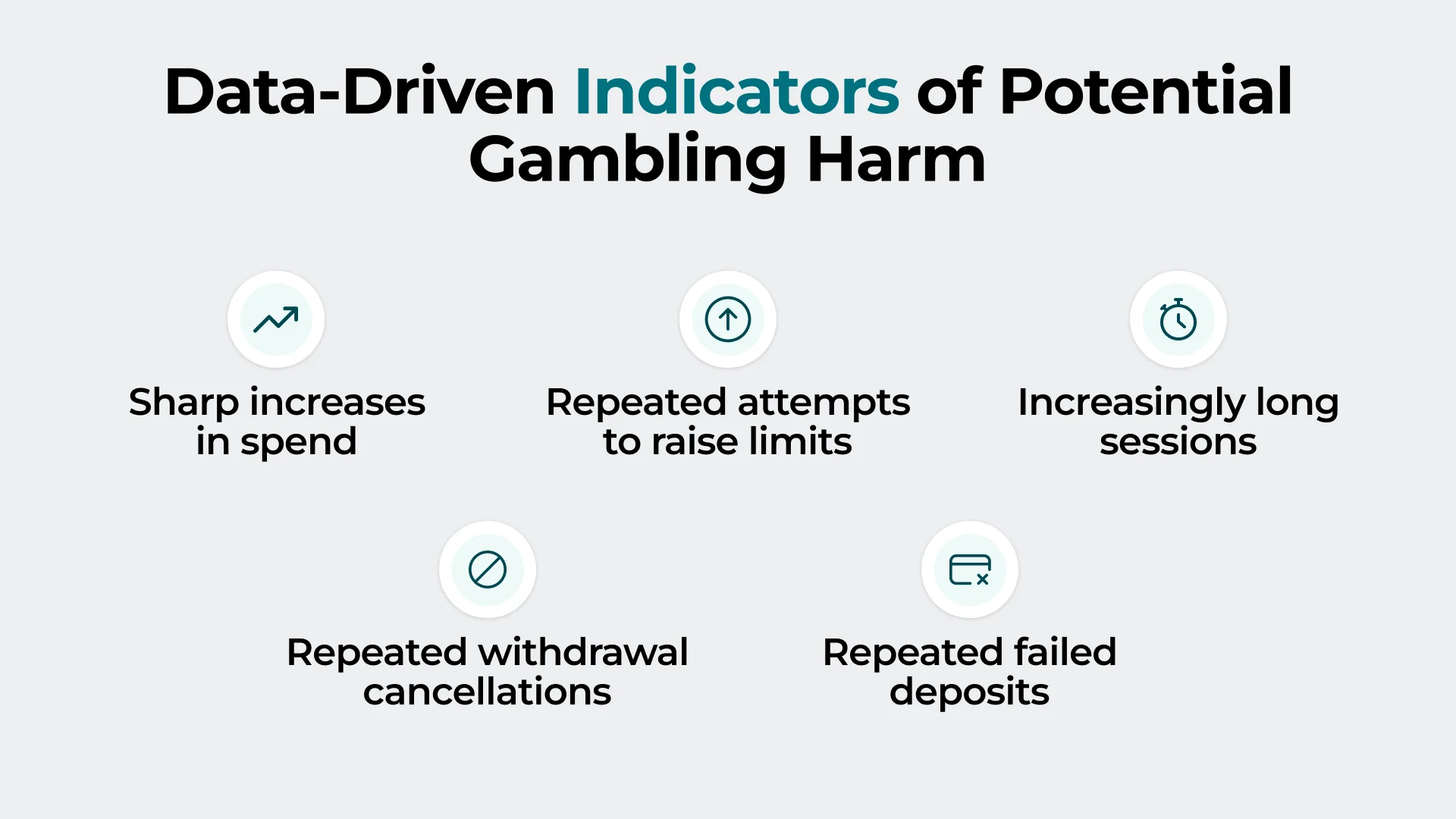
One indicator rarely tells the whole story. It should be read against the player's account history and other signals. Where required by the jurisdiction, affordability or financial-vulnerability data also comes into play, helping operators assess whether spending may be unsustainable.
That assessment feeds a customer interaction workflow. In practice, the workflow defines:
- when to contact the player;
- who handles the case;
- what response is proportionate;
- when escalation is required.
Measures may range from a tailored message to marketing restrictions or account-level controls.
Staff training makes this process consistent. Employees need to recognise indicators, follow approved scripts and know when to escalate. Audit trails should record the evidence reviewed, the decision reached and the action taken, giving compliance teams a clear basis for later review.
For a practical example, consider the UK Gambling Commission's framework that includes three elements of customer interaction: identify, act and evaluate. Operators identify possible harm, take timely and proportionate action, and then assess whether the player's behaviour or risk indicators have changed.
If concerns remain, the intervention can be adjusted or escalated and monitoring continues. The key point is that effectiveness must be measured: these player protection tools require governance as much as analytics.
Self-Exclusion, Blocking Software, and Bank-Level Controls
Continuing with the UK, it is worth noting that these controls form a layered protection model. Self-exclusion tools let a player block access through one operator or a wider scheme. Blocking software restricts sites and apps on a device, while a bank gambling block can stop card payments to gambling merchants.
Together, the layers close different routes to play. The real value comes from combining account, device and payment controls.
Within this model, GAMSTOP Online covers sites and apps run by operators licensed in Great Britain. Land-based schemes include GAMSTOP Betting Shops (formerly MOSES) for betting shops, SENSE for casinos and BISES for bingo premises. Each covers a distinct category, so its scope should be stated clearly.
Beyond scheme-based exclusion, Gamban and BetBlocker provide the device layer, while banks supply payment blocks. These access controls sit outside the casino and can reinforce a formal exclusion when one measure cannot cover every site or payment route.
Another useful source is GambleAware, which commissioned research, prevention and treatment services across Great Britain. The charity closed in March 2026 as the new statutory system took over, so its published materials can now be used as research and policy references.
Current support links should lead to active local providers. In the UK, GamCare is a charity that runs the National Gambling Helpline and offers advice, digital tools and referrals for people affected by gambling harm.
TalkBanStop provides a practical example of how these layers work together. The partnership between GamCare, GAMSTOP and Gamban ended in March 2026, so objective conclusions can now be drawn. Its final evaluation found better outcomes when emotional support, self-exclusion and blocking software were combined.
The takeaway is clear: these measures should form one connected protection journey.
The US model is state-led, so self-exclusion varies by jurisdiction. For example, New Jersey and Pennsylvania regulate iGaming and offer online self-exclusion routes; Pennsylvania also includes deposit, wager, spend and time limits. New York, in turn, offers voluntary self-exclusion, while online casinos and prediction markets remain unlawful.
2026 Regulatory Context: UK and US Signals
Responsible gambling tools require market-specific configuration. In Great Britain, the UK Gambling Commission sets market-wide requirements.
Affected remote licensees must run Financial Vulnerability Checks when deposits minus withdrawals exceed £150 over a rolling 30-day period. The threshold has applied since 28 February 2025 within wider customer-interaction duties.
Financial Risk Assessments are separate credit-reference assessments for high-spending customers in current financial difficulty. As reported in the Commission's July 2026 update, staged implementation will begin at very high spend.
Stake limits operate at product level. The £5 cap for players aged 25+ took effect in April 2025; £2 for those aged 18–24 followed in May. Both apply per online slot game cycle, excluding roulette and blackjack.
From 30 September 2026, the revised RTS 12 wording requires operators to offer gross deposit limits, while net deposit, stake and loss limits remain optional. Increases require at least 24 hours and confirmation; reductions must be immediate unless technical failures prevent it.
Bear in mind, though, that US rules vary by state and product. The National Council on Problem Gambling (NCPG) is a nonprofit whose 2026 Internet Responsible Gambling Standards provide an online benchmark for iGaming, sports betting and emerging products. Its separate Responsible Gambling Framework is designed for lotteries.
For operators, this translates into market-specific planning. Licensing assistance can support jurisdiction mapping and help identify points that require closer review. Reviews like this one do not constitute legal advice; the final interpretation and configuration should be reviewed with qualified counsel in the relevant jurisdiction.
Responsible Gambling Tools for Prediction Market Solutions
In iGaming, prediction market solutions are a third-party product category: software and related services that let an operator launch a separate vertical for predicting real-world events. The category covers two different models.
- One model comprises CFTC-regulated prediction markets, where event contracts derive their value from an event outcome.
- The other model comprises fixed-odds event-betting products marketed by some iGaming suppliers as prediction-market platforms.
This is where consumer protection becomes critical. Sports event contracts and fixed-odds products can offer frequent chances to risk money on uncertain outcomes; chasing losses and escalating spend may follow.
The NCPG therefore recommends comparable safeguards regardless of legal classification. It also warns that trading or investment language can mask gambling-like risk.
Marketing should present the activity as entertainment-based, clearly distinct from financial investing. Responsible messages must reflect the actual product mechanics and uncertainty of outcomes.
At entry, age verification should enforce the applicable threshold. Clear risk disclaimers should explain possible losses, fees and outcome uncertainty. Contract terms, settlement rules and dispute routes should also be easy to find.
After onboarding, account history and spending data help users track their activity. Spend and deposit limits, cooling-off periods and self-exclusion provide continuing control. Behavioural monitoring should detect risky patterns and trigger an appropriate response.
The 10 June 2026 CFTC proposal remains a Notice of Proposed Rulemaking focused on the review of certain event contracts. Depending on the product model and jurisdiction, the responsible gambling tools discussed in this section may be legal requirements, formal recommendations or emerging best practices.
iGaming businesses working with sports betting software will recognise much of this control set. Prediction-market products still need a separate assessment because contract mechanics, settlement and regulatory treatment can differ.
How to Design a Responsible Gambling Toolkit for an iGaming Platform
A casino platform should support one end-to-end control journey across the account and back office. Before configuration, map these parameters for each jurisdiction:
- age thresholds;
- limit types;
- activation periods;
- self-exclusion scope;
- approved support routes.
Every touch point matters. Put the controls in a prominent account area where users can check activity, set limits in a few steps, take a break or enter self-exclusion directly.
Apply reductions immediately. As for the increases, they should follow jurisdiction-specific cooling-off rules and require confirmation after the delay.
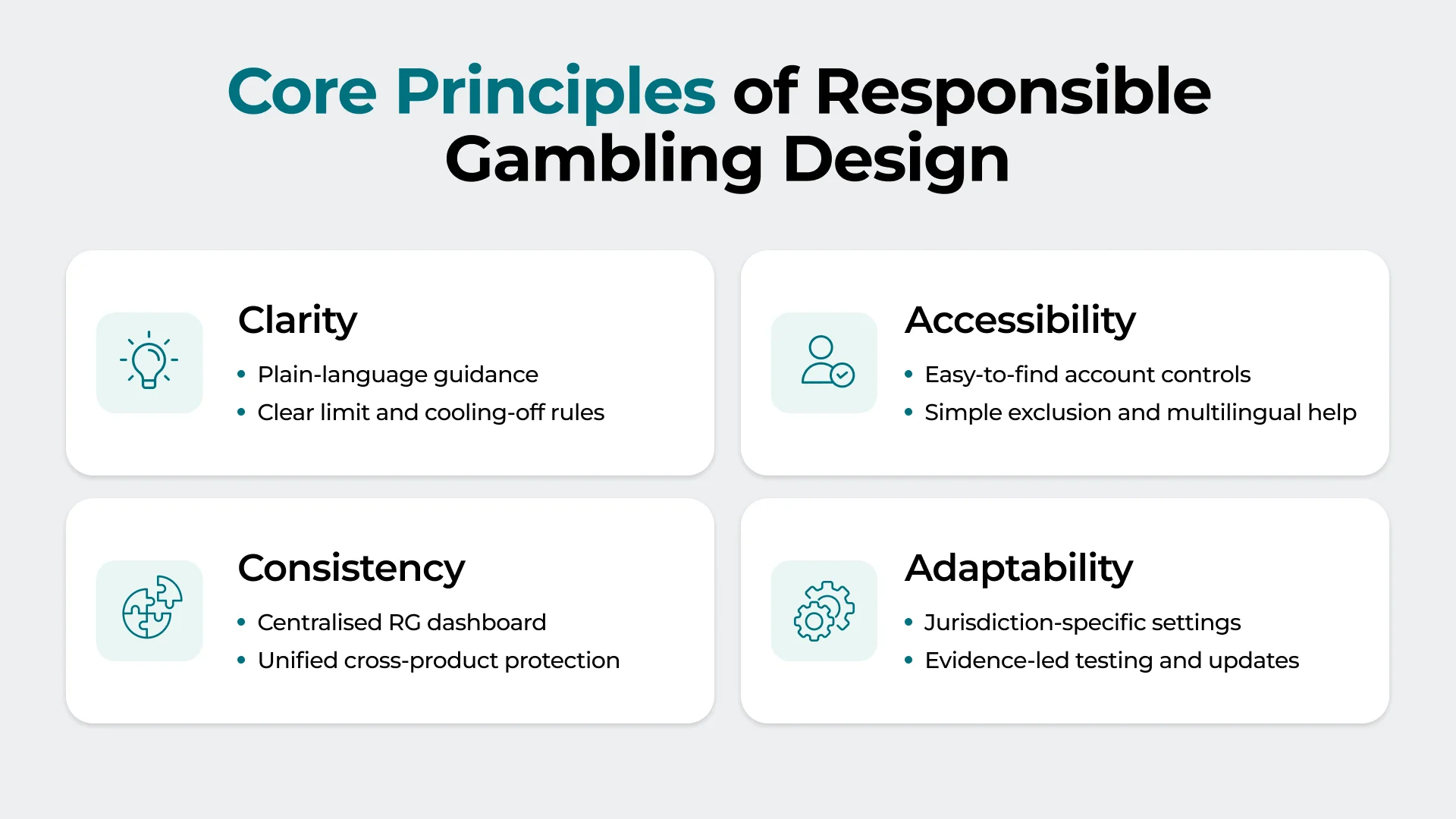
A centralized responsible gambling dashboard should give authorised teams one view of active limits, exclusions, risk flags, interventions and contact history.
- Use a shared event model with consistent timestamps and product IDs for deposits, withdrawals, wagers, sessions, limit changes and marketing responses.
- Keep event logs, staff notes and policy versions for compliance reporting and review.
- Provide plain-language multilingual help, with current links to each jurisdiction's helplines, self-exclusion schemes and dispute routes.
- Automate protection: self-exclusion and other high-risk statuses should block relevant product access and suppress promotions across connected products and channels.
As with all player-protection flows, careful testing matters. Track uptake, abandoned steps, intervention responses and recurring risk signals, then fix friction or weak outcomes.
A responsible toolkit should fit the operating model from day one. Its architecture may be modular, but users should experience one coherent set of boundaries across payments, games, support and marketing.
Common Mistakes to Avoid
- Burying controls in account settings. A user may need them during a deposit, a long session or a sudden decision to stop.
- Allowing immediate limit increases. Where required by applicable rules, a pause and later confirmation create distance between the initial impulse and the change.
- Reducing responsible gambling to a footer link. It should be built into the player journey through accessible information and controls, trained staff, risk monitoring and support.
- Relying on self-exclusion alone. Effective protection also requires other operator-provided controls and clear access to external tools and support.
- Using the same setup in every jurisdiction. Age thresholds, cooling-off rules, self-exclusion schemes and mandatory wording vary by market.
- Publishing "play responsibly" without a next action. A useful message points to a limit, a break, account history or support.
- Counting interventions without evaluating them. Volume says little about whether risk changed or the user received appropriate support.
Conclusion
Responsible gambling works best as layered protection. A strong toolkit connects player control with operator monitoring, keeps specialist help within reach and translates regulatory requirements into product behaviour. Regular evaluation shows where the model needs to change.
For operators planning casino or prediction-market-adjacent products, safer gambling requirements should shape platform architecture from the outset. It should support market-specific controls and shared risk data while giving users clear access to current, jurisdiction-appropriate gambling harm prevention resources.
FAQ
What is Responsible Gambling?
Responsible gambling is an approach that treats gambling as entertainment within personal money and time limits. It combines informed decisions with safeguards that help users track activity, pause or stop play and reach support before harm escalates.
What are Responsible Gambling Practices?
Responsible gambling practices are habits that keep play within personal boundaries. A person sets a budget and time limit, understands the odds and treats gambling as entertainment rather than income. Taking breaks and never chasing losses help maintain control; if it slips, the right step is to stop and seek help.
What are Responsible Gaming Tools?
These tools are controls and support options that help users manage gambling risk. Platform features include money and time limits, reminders, cooling-off and self-exclusion. Blocking software and bank controls work beyond the casino account, while support links lead to qualified help.
What are the 4 E's of Gambling?
In academic gambling research, the Four Es most commonly refer to "Escape, Esteem, Excess and Excitement". This psychological model covers factors associated with the risk of problem gambling and forms the basis of a 40-item measure. Less commonly in iGaming, the term means "Education, Environment, Enforcement and Evaluation", connecting risk awareness and safer play conditions with the application and assessment of safeguards.
What is the 1% Rule in Gambling?
The 1% rule is not a strict limit but a flexible bankroll-management guideline that suggests staking around 1% of a predefined gambling budget on a single bet. The percentage may vary as part of a wider budgeting approach. It does not guarantee safety or prevent gambling harm, while firm spending, loss and time limits provide broader control.
Why do Prediction Markets Need Responsible Gambling Tools?
These tools are needed when prediction-market products cover sports or other event outcomes and function like wagering. Repeated financial risk can create similar harm patterns, so comparable safeguards should set boundaries, identify risky behaviour and make it easier to step away.