


Table of Contents
In 2026, a Brazil gambling license is one of the clearest entry points into LATAM iGaming. Latin America’s largest country has moved from long uncertainty to federal authorization, and the Brazil gambling market now attracts operators focused on long-term development.
Brazil’s sports culture runs deep, with football at its center, while the growth of online entertainment makes the market even more attractive. It's no wonder that iGB cites Brazilian players as the world's largest source of traffic to gambling websites. Therefore, for many operators, obtaining a Brazilian license becomes a key part of their business strategy for expanding into promising new markets.
At the same time, the legal framework sets a serious threshold.
Brazil Gambling License: Cost, Term, and Scope
Law No. 14,790/2023 marked a turning point for the regulated betting market. It created a clearer framework for obtaining a Brazil gambling license, covering fixed-odds betting on real sports events as well as online casino games offered through digital channels.
Brazil’s regulated online betting and iGaming market went live on January 1, 2025. Under the current federal framework, a Brazil online gambling license is issued by the Secretariat of Prizes and Betting (SPA/MF), a unit within the Ministry of Finance. SPA/MF grants authorizations, defines technical requirements, monitors the sector, oversees compliance, and imposes sanctions when operators breach the rules.
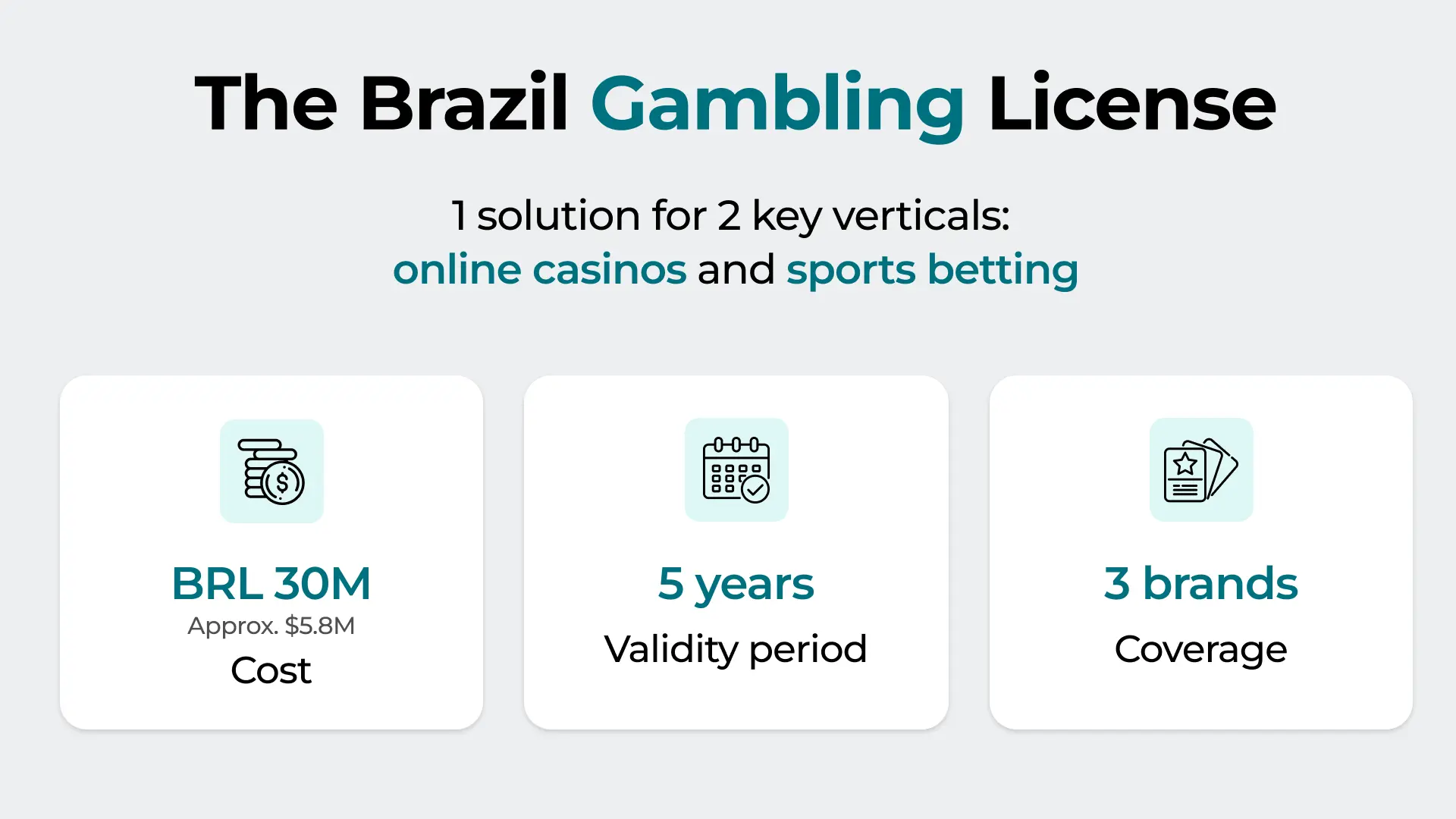
The regime is competitive. The Ministry of Finance may authorize multiple qualified applicants, but each Brazil gambling license is personal, non-transferable, and valid for 5 years. The fee is 30 million Brazilian reais and can cover up to 3 commercial brands.
Brazil’s regulated market launched with 14 licensed operators, while by June 2026 the public SIGAP consultation page already showed 314 authorization processes. SIGAP is Brazil’s official betting management system, used by SPA/MF to handle applications and public authorization data.
For the Brazil gambling market, this signals clear regulatory momentum and strong operator interest.
For operators looking beyond Brazil, offshore gambling licensing options may be relevant in selected LATAM markets, depending on local rules and the business model. A broader view of Curaçao, Anjouan, and other routes, together with compliance support across jurisdictions, helps operators choose suitable solutions for different strategies: first launch, scaling, or traffic monetization.
What Operators Need to Know about Brazil Gambling Laws
Under the law, betting activity may be conducted only by companies authorized by the Ministry of Finance. For a foreign market player, this means that entry requires:
- a company incorporated in Brazil;
- local headquarters and management;
- at least 20% of share capital held by a Brazilian shareholder;
- documented legal, tax, financial, and technical readiness for SPA/MF review.
The Brazil gambling laws also require the applicant company’s primary corporate purpose to be the operation of fixed-odds betting.
Sports sponsorship needs special attention. If an operator wants to sponsor Brazilian football clubs or sporting events, it needs authorization and must operate through the required bet.br domain. This can make or break local brand visibility.
The law also sets specific requirements for operators. Applicants must:
- meet minimum capital requirements;
- prove relevant experience in gaming or betting;
- maintain cybersecurity standards;
- have a customer service structure in place;
- appoint a director responsible for relations with the Ministry of Finance.
To obtain and maintain a Brazil gambling license, operators must have documented internal policies and controls. These policies should cover customer service, anti-money laundering, and counter-terrorist financing.
They must also cover responsible gaming and betting integrity. In addition, operators need procedures to prevent match-fixing, fraud, and other forms of manipulation.
Key Costs behind Brazil Market Authorization
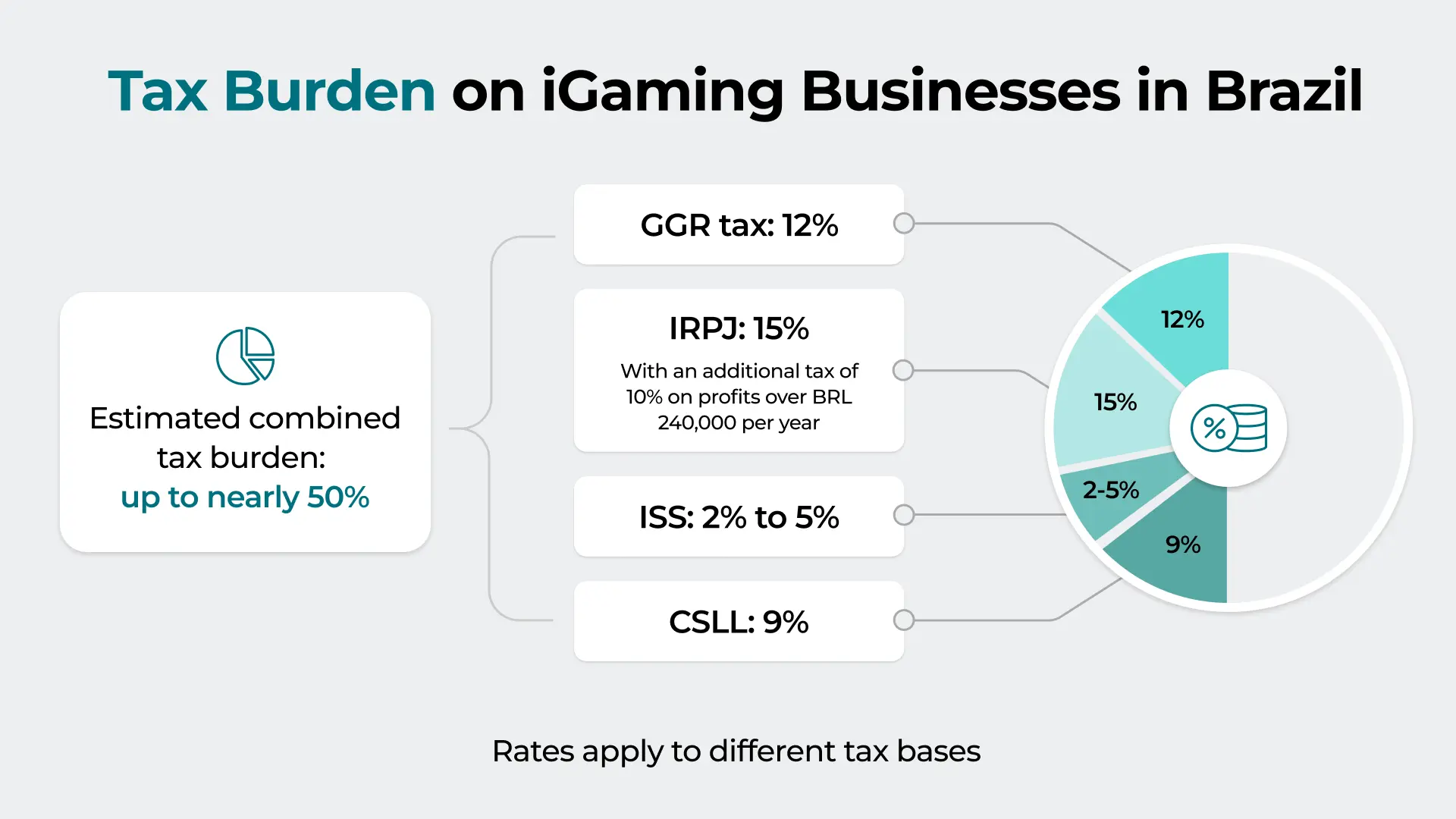
The budget for a Brazil online gambling license starts with the BRL 30 million five-year authorization fee. Besides this, the main recurring obligations include revenue-based taxation, profit-based taxes, social contributions, and other compliance costs.
- GGR tax — 12%. This levy applies to gross gaming revenue, meaning the total amount of bets accepted minus winnings paid to players. The collected amount is allocated to the state budget and then distributed to social and sports programs across Brazil.
- Corporate Income Tax (IRPJ) — 15%. Operators pay this tax on net profit. If annual profit exceeds BRL 240,000, an additional 10% tax applies to the amount above that threshold.
- Municipal Service Tax (ISS) — 2% to 5%. For electronic services, the rate depends on the municipality where the company is registered.
- Social Contribution on Net Profit (CSLL) — 9%. This contribution is calculated on taxable profit and goes to Brazil’s social security system.
These rates should not be read as a simple addition, because they apply to different tax bases. In practice, industry guidance often describes the combined tax burden as approaching 50%, depending on revenue, tax regime, and municipality.
Obtaining a gambling license in Brazil also requires proof of financial strength. Applicants must show BRL 30 million in minimum capital and net worth, and they must create a financial reserve of at least BRL 5 million. The reserve is part of the safety net behind the regulated model.
In addition to these financial requirements, technical certification should be budgeted as a separate workstream, because independent testing can affect launch timing and require platform or security fixes before go-live.
Brazil Gambling Demographics and Player Protection
Brazil is a large, urban, and mobile-first market. Its player base is shaped by mass internet access, strong sports culture, and the growth of online entertainment. The core real-money audience is not limited to very young users: market research points to active adult players, with the strongest group around 25–40.
For Brazil gambling demographics, this creates a broad acquisition base. Sports betting is especially important because football is part of everyday culture, while mobile access makes betting and online casino products easier to reach. Operators should therefore plan for:
- high demand;
- fast onboarding;
- localized Portuguese-language support.
Reflecting the trend towards the creation of mature legal systems for regulated jurisdictions, current Brazil gambling laws connect market access with player protection. Operators must keep advertising clear, honest, and limited to adults. They must also protect personal data under LGPD and avoid acquisition practices that create regulatory risk.
In this sense, Brazil gambling demographics should guide not only marketing, but also compliance, responsible communication, and safer player journeys.
How to Apply for the Brazil Online Gambling License
To apply for a Brazil gambling license, the operator submits the request to SPA/MF through SIGAP. Forms and supporting documents must be filed electronically and signed through accepted digital credentials.
The application package should prove legal standing, fiscal compliance, good reputation, financial capacity, and technical qualification. Getting clear on this early can save months, especially when documents come from different jurisdictions.
SPA/MF generally reviews an application for a Brazil online gambling license in up to 150 days. After approval, the operator has 30 days to pay the BRL 30 million grant fee, submit the payment receipt, and provide the remaining required documents.
If information is missing or unclear, SPA/MF can request more documents during the review.
After Approval: How to Launch in Brazil
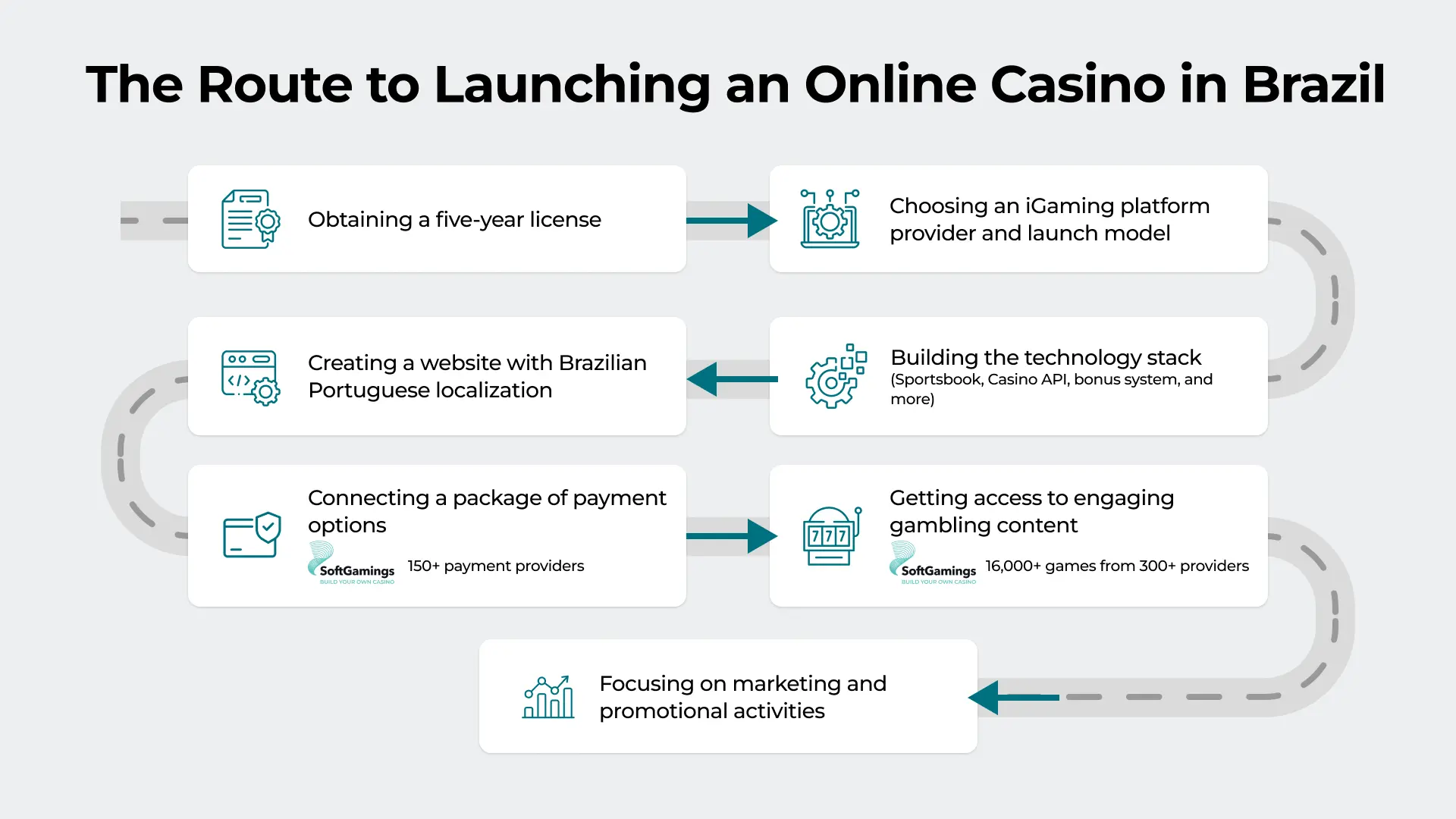
Once authorization is in place, launch work shifts from licensing to execution. Operators need a production-ready platform with strong back office, localized content, Portuguese support, and reporting routines from day one.
For teams that already have a gambling license in Brazil and want more control over their new brand, a Turnkey casino setup offers a practical balance between ownership and operational support. The operator keeps freedom over the design, servers, and customization, while SoftGamings helps close the gap between software deployment and market-ready operations.
After approval, the path runs from choosing an iGaming software provider to setting up localized content that fits Brazilian player habits.
FAQ
Is Gambling Legal in Brazil?
Yes. Online casino games and fixed-odds betting are legal when offered by companies authorized by SPA/MF. The Brazil gambling laws allow regulated online operations based on a 5-year license that also covers sports betting.
How Much Is a Gambling License in Brazil?
The federal authorization fee is BRL 30 million and covers up to three commercial brands. The wider Brazil gambling license budget should also include capital requirements, certification, taxes, and compliance operations.
What Are the Financial Requirements for a Brazilian License?
Applicants need BRL 30 million in paid-in capital and net worth, plus a BRL 5 million financial reserve. They should also budget for the wider tax and compliance burden, which can reach 50% depending on the applicable tax base and the municipality where the company is registered.
Can Foreign Bookmakers Operate in Brazil?
Yes. A foreign group may apply for a Brazil online gambling license if it meets local ownership, capital, and technical requirements.
What Payment Methods Should Operators Connect when Entering the Brazilian Market?
When entering the Brazil gambling market, operators should prioritize Pix as the key local payment method and support compliant account-based transfers through financial institutions or payment providers authorized by the Central Bank of Brazil.